Sunday, 2 November 2014

US and Canadian F-22 fighter jets scrambled to intercept six Russian military planes near Alaska

Six Russian military planes have been intercepted off the coast of Alaska as they approached North American airspace.


US and Canadian fighter jets were scrambled to intercept the aircraft in two incidents on Wednesday and Thursday, according to military officials.
The Russian planes - two MiG-31 fighters, two Bear long-range bombers and two IL-78 refuelling tankers - had entered America's air defence identification zone but not crossed into US air space.
Lt Col Michael Jazdyk, from the North American Aerospace Defence Command (NORAD), said the US jets intercepted the planes about 55 nautical miles from the Alaskan coast at 7pm local time on Wednesday.
He said the fighter jets were scrambled “basically to let those aircraft know that we see them and in case of a threat, to let them know we are there to protect our sovereign airspace”.

READ MORE...

Total darkness: Country-wide blackout in Bangladesh as power grid collapses (PHOTOS)


Imagine what happens when electricity is cut off nationwide in a country of 160 million people. In Bangladesh, everyday life was brought to a standstill on Saturday as factories, hospitals, and homes plunged into darkness or had to rely on generators.

Even the prime minister’s official residence was left with no electricity, as the small but extremely densely populated South Asian country experienced one of the worst blackouts in world’s recent history.

A general view shows Dhaka during a power blackout on November 1, 2014 (AFP Photo / Munir uz Zaman)
“The national grid collapsed so the whole country lost power,” Reuters quoted Mohammad Saiful Islam, a director of the state-run Bangladesh Power Development Board, as saying. “Our repeated efforts to restore electricity across Bangladesh failed repeatedly.”

Local media reported that the blackout was caused by the failure of a transmission line transporting electricity from India. India’s Power Grid Corp, however, said there were no problems on their side of the border.


Bangladesh fishmongers light their fish stalls with candles during a power blackout in Dhaka on November 1, 2014 (AFP Photo / Munir uz Zaman)
“I can’t run my shop without power and no one seems to care,” Mohammad Ripon, owner of a grocery store in the capital of Dhaka, told the agency. “It has been about eight hours now and still there is no word on when the power will come back.”

The airport and main hospital in Dhaka are running on emergency generators.


A Bangladesh woman fans a sick child during a power blackout at a hospital in Dhaka on November 1, 2014 (AFP Photo)
Garment factory owner Anwarul Alam Chowdhury said he was able to get 2-3 hours’ worth of power out of his generator, but then had to halt the factory’s output.

“This is a big slap for my business,” he said, explaining that many other factories were forced to shut down production as well.


A Bangladesh patient lies on her bed during a power blackout at a hospital in Dhaka on November 1, 2014 (AFP Photo)
Bangladesh’s plunge into darkness provides a glimpse into a recently debunked hoax about NASA confirming six days of ‘total darkness’ in December.

The hoax went viral on Twitter, leaving many people shocked and bewildered as to how the experience would feel.


SOURCE: RT

Saturday, 1 November 2014

Scientists Find Chances Of Fighting Ebola May Hinge On Genetics

ebolagenetics
New research from a level four lab in Montana done on Ebola-infected mice indicates that genetics might play an enormous role in surviving Ebola. The research was reported in the journal Science. Systems biologists and virologists Michael Katze and Angela Rasmussen led the research. The scientists now believe that some people may have genes that initiate reactions inside their bodies that limit the severity of Ebola infection. In October, the Inquisitr reported that scientists believe that many people may be immune to Ebola.
“There is limited evidence from past outbreaks that suggests there probably are quite a few people who get exposed, who get infected, without ever developing symptoms and without ever developing illness, but they develop immunity,” researcher Lauren Ancel Meyers explained, discussing the topic of Ebola immunity. The new report from Science appears to substantiate the idea that some people are naturally immune. The new research is a collaborative effort between scientists at National Institutes of Health’s (NIH) Rocky Mountain Laboratories in Montana, the University of North Carolina at Chapel Hill and the University of Washington in Seattle.
The researchers found that the death rates in the Ebola-infected mice appeared to coincide with specific genetic patterns. First, the scientists used mice that had been developed to study the genetics involved in the severity of influenza and “used them to breed strains that replicate the main features of human Ebola hemorrhagic fever,” according to Medical News Today.
The researchers discovered that 19 percent of the Ebola-infected mice were not severely affected by Ebola and, of this group, all survived and suffered no lasting effects. Another 11 percent of the Ebola-infected mice showed partial resistance to the Ebola virus, and less than half of this second group died. The remaining 70 percents of the mice had severe symptoms of their Ebola-infection. Of this 70 percent, over half of them died.
The mice with the most severe reactions that died had a genetic make-up that allowed the Ebola virus to inflame blood vessels and promote cellular death. The mice that fared well in the experiment had a a genetic make-up where Ebola exposure activated genes that control the repair of blood vessels and encouraged immune cell production.
A press release from the University of Washington Health Sciences/UW Medicine stated, “While acknowledging that recent Ebola survivors may have had immunity to this or a related virus that saved them during this epidemic, Katze said, ‘Our data suggest that genetic factors play a significant role in disease outcome.’”
The researchers also found that there could be something specific about the livers in the mice that survived Ebola with less severe symptoms. They question whether specialized liver cells in these mice might have limited the Ebola virus replication, again indicating a possible genetic susceptibility to damage from the virus.


SOURCE Scientists Find Chances Of Fighting Ebola May Hinge On Genetics

Strategic Relocation: The Reality Of Survival Communities and Ready Retreats

Strategic Relocation: The Reality Of Survival Communities and Ready Retreats

Child Infected with Ebola Had Contact With 141 People in Mali

Child Infected with Ebola Had Contact With 141 People in Mali


Cha-Ching: The Second Fast-Tracked Ebola Vaccine Trial Just Began in Maryland
While the United States continues to ignore the threat of Ebola, and refuses to enact any kind of travel ban for West Africa, the nation of Mali witnessed first hand just how difficult it can be to contain the disease. After traveling from Guinea, a little girl managed to slip past the screening process at the border, despite having symptoms. It goes to show you that even when you try your best to regulate the flow of people, somebody will always slip through the cracks.
The first leg of the girl’s journey took her from the border to Bamako by bus. Six of the 10 passengers remain unknown. She then went to and from the Bagadadji neighborhood in 5-seater taxis, with one person in each taxi ride still unknown. It was not clear from the presentation if those were the drivers.
She then sat by the window on a bus from Bamako to Kayes, and 34 contacts from that journey remain unaccounted for.
Nobody at WHO was immediately available to answer questions about the data contained in the presentation.
Contact tracing is seen as the key to stopping new outbreaks. Nigeria and Senegal have already beaten Ebola by meticulous contact-tracing and regular checks on all the contacts who were identified.
The risk of the disease spreading to new areas comes just as the first glimmer of hope appeared at the disease’s epicenter, with some signs of a slowdown in its spread in Liberia, although the WHO has said Ebola remains “rampant” in Sierra Leone.

What’s truly frightening is how many people are unaccounted for. Less than half of 141 individuals she came into contact with have been found, and only a handful have been tested for the disease.
Also keep in mind, that whatever procedures the nation of Mali has in place to stop the infected from crossing over into their country, they’re still far superior to what the United States has done. We’ve left our borders wide open, and have done next to nothing to prevent the virus from spreading onto U.S. soil. Other Western countries like Canada and Australiahave taken the threat very seriously, and have enacted some of the first travel bans to West Africa. Why can’t we?
Instead, our government is covering its ears, and pretending there’s nothing there. They continue to assure us that everything is under control, while behind the scenes they speak the truth.
So even when a country does its best to stop the spread of a disease, bad thing can still happen. But, what happens when a nation does absolutely nothing to mitigate the risk of a pandemic? Time will tel

Halloween: Experts Cite Studies That Say Holiday Makes Children ‘Evil’

evil children
Call it a Halloween cocktail: costumes, candy and trick-or-treating. Experts say that it’s the combination of those three things that make children more “evil” this time of year, and according to studies, they’ve got the science to back up the claim.
Both the existence of group settings – as often experienced when trick-or-treating with friends or in crowds on Halloween – and the wearing of masks or costumes, can both incite what is known in social psychology as deindividuation. The concept is generally thought of as the losing of self-awareness in groups.
As a result of deindividuation, people – in the case of Halloween, children – become less likely to evaluate their own behavior and lose a sense of what is right and wrong. All of this stems from the mind’s innate knowledge that one is less likely to be recognized while wearing a mask and/or costume, or while being only one individual in a large group.
The American Psychological Association did a study in which a number of children were the test subjects, half of whom wore Halloween masks and half who did not. A bowl of candy was in the in the room, and the scientist dispensing the test rises to leave. Before doing so, the scientist told the child that they could only have two pieces of candy while they were alone. The effects were definitive. The masked children overwhelmingly took more candy from the dish while they were alone then the unmasked children did. The study was also performed with children left in groups, as well as children left alone individually. Again, the children that were left in groups “stole” more candy than those that were left alone.
Another study quoted by the American Psycholocical Association, dealt with Halloween directly.
“Concealed raters unobtrusively observed approximately 1,300 trick-or-treating children who were assigned to various conditions and given an opportunity to steal candy and money. Significantly more stealing was observed under conditions of anonymity and in the presence of a group. There was also an Anonymity-Group interaction. Altered responsibility affected the transgression rate only when both the leader and members were anonymous. The highest rates of stealing occurred among anonymous children in groups with altered responsibility.”
There’s no doubt about it, Halloween makes children evil. So, tonight, when you’re sending out your little ghouls and goblins and witches and skeletons, don’t be surprised if they feel free to “bend the rules” a bit when it comes to good behavior.

Google CEO: Computers Are Going To Take Our Jobs, And 'There's No Way Around That'


When Google co-founders Larry Page and Sergey Brin formed the company in 1998, they sought to package all the information on the internet into an index that's simple to use.
Today, Google is much more than a search engine. The company appears to be involved in every type of new technology ranging from self-driving cars to contact lenses that can test for disease.
In a recent interview with the Financial Times, CEO Larry Page provided some insight as to why the company has decided to take on so many different tasks.
Part of the reason is because Page believes there's this inevitable shift coming in which computers will be much better-suited to take on most jobs. 
"You can't wish away these things from happening, they are going to happen," he told the Financial Times on the subject of artificial intelligence infringing on the job market. "You're going to have some very amazing capabilities in the economy. When we have computers that can do more and more jobs, it's going to change how we think about work. There's no way around that. You can't wish it away."

READ MORE...


The Bank of Japandemonium at work in all its glory!

SOURCE: WOLF RICHTER

With impeccable timing – on Halloween,which is increasingly popular in Japan among adults who are trying to escape their reality – Bank of Japan Governor Haruhiko Kuroda formally announced that he’d cure Japan’s economic and fiscal ills by resorting entirely, and not just partially, to “monetary shamanism.”

That’s what Izuru Kato, an economist and president of Totan Research, calls Kuroda’s dubious strategy. Japan practiced QE before it ever become a term in English. With predictable results: it did nothing for the economy but triggered unbridled government profligacy that generated ever larger budget deficits and an insurmountable mountain of debt.

But the QE that the BOJ has unleashed since April 2013 isn’t just QE anymore. It’s QQE: quantitative and qualitative easing. No-holds-barred QE. So in the true spirit of Halloween, Kuroda promised that the BOJ would:

  • Increase the monetary base by ¥80 trillion annually (over 16% of GDP!), up from the previous commitment of ¥60-70 trillion. In a few years, its balance sheet will exceed Japan’s GDP.
  • Increase its JGB holdings by ¥80 trillion annually, up 60% from the prior insanity.
  • Lengthen the average remaining maturity of its JGB holdings to 7-10 years, up from the current goal of 6-8 years. Before Kuroda arrived at the BOJ, the average maturity was under 3 years.
  • Triple the annual purchases of ETFs and J-REITs.
  • And keep doing all of this until hell freezes over.
The goal is to demolish the yen, savings, real wages, people’s wealth, and that onerousness mountain of debt, much of which will end up on the BOJ’s balance sheet in a few years. And it seems to be working.

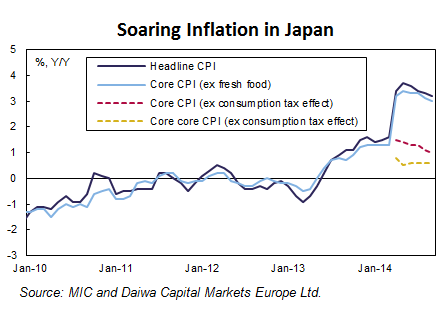
As planned under the economic religion of Abenomics, inflation has roared higher. In September, prices were 3.2% compared to a year ago, with goods prices up 4.6% and service prices up 1.9% (service providers are so pressured by struggling consumers and businesses that they’re eating the 3-percentage-point consumption tax increase rather than passing it on). Here is what that inflation looks like:

Japan-CPI-2010-2014_September

Unperturbed, the BOJ uses its own and more convenient measure of inflation, taking out just about everything that adds to it, such as food, energy, and the impact of the consumption tax increase, to come up with a new and much tamer price index – the yellow dotted line in the chart above – which is still too low and has to be jacked up further.

But wages aren’t rising, so households – which do have to pay for food, energy, and the consumption tax hike – are having a hard time making ends meet. And the increasingly numerous retirees are losing purchasing power and wealth as their savings are being devalued. They’re all coming to grips with the scourge of Abenomics: “inflation without compensation.” It boils down to this, as the Statistics Bureau reported today with equally impeccable timing: In September, inflation-adjusted household incomes plunged 6.0% from a year ago.

And demand? Average monthly inflation-adjusted consumption expenditures by two-or-more-person households plunged 5.6%  from a year ago. It’s the sixth month in a row that expenditures and incomes have plunged in this manner.

The Bank of Japandemonium at work in all its glory!

Its announcement was also impeccably coordinated with another hocus-pocusannouncement, this one by Japan’s Government Pension Investment Fund (GPIF). It confirmed that the mega-fund would slash its holdings of Japanese Government Bonds (JGB) down to 35% of its ¥127 trillion in assets (from 53% at the end of September). The fund will dump its JGBs at a pace that is slightly below the additional purchases by the BOJ. This way, everything remains under control. The market only gets involved for the sake of appearances. Beyond the charade, the GPIF will hand its JGBs to the BOJ.

But then the GPIF will plow the newly liberated funds into the stock market to buy up domestic and foreign stocks and foreign bonds – by June! This announcement has been made in various forms for months. Each time such verbiage hit the news, stocks jumped on cue, which was the sole purpose of those announcements.

With the total commitment to monetary shamanism artfully pronounced on Halloween during Japan’s trading hours, pandemonium followed. The Nikkei stock index instantly jumped 5%. The yen collapsed by over 3.5%. In one fell swoop, it cut a big chunk out of the still considerable yen-denominated wealth of the Japanese. And JGB yields dropped further.

It is now perfectly clear that the Bank of Japandemonium has imposed a yield peg, which it continues to tighten. There will never again be a market-based yield for JGBs. Whoever bought them originally will get their money back eventually, but that money will be worth a lot less than what it was worth yesterday. In the interim, they will not earn any measurable yield. And shorting them is useless because the BOJ will simply buy every one that isn’t nailed down.

There is no exit. In a few years, the BOJ’s balance sheet will reach the size of Japan’s GDP, but it won’t be able to stop there. It can never allow the market to set the yields. It would instantly bankrupt the country. Politicians and the Japanese economy have already become totally addicted to government deficit spending and can’t shake the habit. But they know they don’t have to; the BOJ will just print the money.

And the BOJ socked it to foreigners who thought they could make a lot of money in Japanese stocks and then convert their gains into dollars. The destruction of the yen will see to it that those gains will be minimal. Worldwide, markets rallied after the announcement, in anticipation of what? True financial pandemonium? Because that’s what this sort of monetary shamanism will lead to.

By comparison, and only by comparison, the Fed has been practically tame. But the impact of its policies since the financial crisis are now clear: for individual Americans, economic “growth” has meant the opposite.