
Wednesday, 29 October 2014

Binyamin Netanyahu ‘chickenshit’, say US officials in explosive interview
US relations with Israel have plunged to new depths of bitterness and hostility as senior officials in the Obama administration decried Binyamin Netanyahu as a “chickenshit prime minister”, “coward” and a man more interested in his own political survival than peace.
The furious assessment delivered in anonymous but no-holds barred commentsin an interview with the American journalist Jeffrey Goldberg in the Atlantic underline a state of anger with Netanyahu that is characterised as “red hot”.
The remarks are particularly telling in having been made to Goldberg, a Washington insider who has interviewed both Obama and Netanyahu, and who warned US-Israeli relations were in a “full-blown crisis” that could only get worse after the midterm elections.
Speaking to the Israeli parliament – the Knesset – a few hours after the comments were revealed, Netanyahu angrily insisted he was “under attack simply for defending Israel”, adding that he “cherished” Israel’s relationship with the US.
READ MORE...
Was The Swedish Hunt for The ‘Russian’ Sub Complete BS?
There was no Russian distress call. That’s the opinion of a Swedish signal intelligence (SIGINT) source after a massive $2.8mn military and media sub-hunt consumed the country for a week.
Reports of a Russian distress signal and a grainy-picture were enough to deploy the navy while the media widely concluded the vessel had to be a Russian submarine spooking Stockholm.
The proof of this was an alleged comms intercept, at distress call frequency, between the supposed sub and Kaliningrad base.
But the Dagens Nyheter daily cited a Swedish Intel source who confessed there was no distress call.
But the Dagens Nyheter daily cited a Swedish Intel source who confessed there was no distress call.
Citing freedom of information requests and its own sources, the paper said Sweden’s signal intelligence agency knows nothing about the alleged distress calls, and registered no spikes in communication with Kaliningrad at the time.
“I’d be glad to read about that emergency call myself. But it didn’t happen, this information is incorrect,” the newspaper cites a source as saying.
Russia has denied sending any subs to spy on Sweden, or having one suffer an emergency in Sweden’s waters. Sources in the Russian military suggested that the fuss was caused by a sighting of a Norwegian U-boat participating in a joint NATO drill in the Baltics.
READ MORE...
Globalization = Permanent Instability
SOURCE: CHARLES HUGH SMITH
Globalization continually creates imbalances that fuel a perpetual instability that gradually impoverishes every sector other than global capital.
Globalization has two guaranteed consequences: permanent instability and endless boom-and-bust cycles. As noted in Forget "Free Trade"--Focus on Capital Flows, the key engine of globalization is mobile capital: capital that can borrow money for next to nothing in one nation and then move that capital to other nations where yields are higher and opportunities for exploitation riper.
This mobility of capital is an enormous benefit to the owners of the capital, but it creates extraordinary instability for those who are not as mobile. When mobile capital encounters anything that reduces profits--higher taxes and rising labor costs, competition or restrictive regulations--it closes factories and fires its workers in that locale and shifts to another locale with greater opportunities for high returns.
The workers left behind have limited means to replace the lost wages, and the local government often has few resources to repair any damage left by the exploitation of resources. The advantage of mobility is reserved for capital, and to the relatively limited cohort of workers who can immigrate to other nations to find work.
This illustrates two key ontological characteristics of financialized globalization: perpetual instability and a never-ending cycle of boom and bust as capital sparks rapid development in one locale and then moves elsewhere once profits decline.
The scale of global capital is difficult to grasp; trillions of central bank-issued dollars, euros, yen and renminbi are sloshing around the global economy, seeking low-risk profits.
Capital has no loyalty to anything but its own expansion, and the damage it leaves in its wake is of no concern to the owners of capital.
There are even less visible consequences to the globalization of markets, capital and labor. Once goods and services are priced globally, local supply and demand no longer set the local price. As my colleague Mark G. has observed, consumer prices can rise even if there are deflationary surpluses in the local economy because price is set by global supply and demand. As a result, measuring inflation and deflation locally is meaningless in a globalized economy.
This financialized globalization of goods, services, credit and currencies continually creates imbalances that fuel a perpetual instability that gradually impoverishes every sector other than global capital, which being mobile, can exploit the imbalances for its own profit.
Correspondent Mark G. recommended a recent article by China-based economist Michael Pettis, How to link Australian iron with Marine le Pen:
"In a 'globalized' world, no country, not even the US, can protect itself from the consequences of imbalances elsewhere. The global economy is a system in which certain types of imbalances are impossible. I especially focus on the requirement that global savings and global investment always balance, but there are others. Because an imbalance at the global level is impossible. if there are imbalances in one country or region, there necessarily must be the opposite imbalances in another, and the more open an economy, the more likely it is to respond to imbalances elsewhere.
It is impossible, in other words, to understand any non-autarchic economy in the world except in the context of global imbalances.
As I say in my book, The Great Rebalancing: Trade, Conflict, and the Perilous Road Ahead for the World Economy, in a globalized world anything that affects the relationship between savings and investment in one country--and nearly everything affects that relationship -- must have the opposite effect on the rest of the world. There is no way of escaping the fact that imbalances generated in one country become a problem for everyone."
Here is Mark's commentary:
The logically following converse of Pettis' point is that only economies enjoying autarchy in any category of economic activity can ever hope to reach reasonable price stability in those activities, and then only if these activities are also made non-tradable by local practice. Restated, "free trade" between large central states is a prescription for perpetual instability at all levels.
Ricardo's theory of comparative advantage is only advantageous if you enjoy an advantage in a particular field. Otherwise it is merely a road map to rapid impoverishment. The only localized response--even at continental level--is to embark on a series of successive financial bubbles. This is pretty much what we've seen everywhere in the world for the last three decades.
Thank you, Mark, for summarizing the consequence of central bank-funded mobile capital and the imbalances and boom-bust cycles this free money for financiers generates globally.
The American Dream Gone Bust
SOURCE: WOLF STREET
The quintessential ingredient in the stew that makes up a thriving housing market has been evaporating in America. And a recent phenomenon has taken over: private equity firms, REITs, and other Wall-Street funded institutional investors have plowed the nearly free money the Fed has graciously made available to them since 2008 into tens of thousands of vacant single-family homes to rent them out. And an apartment building boom has offered alternatives too.
Since the Fed has done its handiwork, institutional investors have driven up home prices and pushed them out of reach for many first-time buyers, and these potential first-time buyers are now renting homes from investors instead. Given the high home prices, in many cases it may be a better deal. And apartments are often centrally located, rather than in some distant suburb, cutting transportation time and expenses, and allowing people to live where the urban excitement is. Millennials have figured it out too, as America is gradually converting to a country of renters.
So in its inexorable manner, homeownership has continued to slide in the third quarter, according to the Commerce Department. Seasonally adjusted, the rate dropped to 64.3% from 64.7 in the prior quarter. It was the lowest rate in the data series, going back to 1995 (not seasonally adjusted, the rate dropped to 64.4%, the lowest since Q1 1995).
This is what that relentless slide looks like:
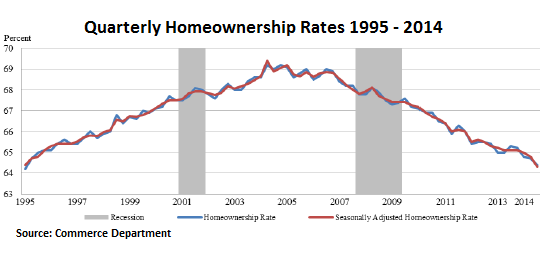
Homeownership since 2008 dropped across all age groups. But the largest drops occurred in the youngest age groups. In the under-35 age group, where first-time buyers are typically concentrated, home ownership has plunged from 41.3% in 2008 to 36.0%; and in the 35-44 age group, from 66.7% to 59.1%, with a drop of over a full percentage point just in the last quarter – by far the steepest.
Homeownership, however, didn’t peak at the end of the last housing bubble just before the financial crisis, but in 2004 when it reached 69.2%. Already during the housing bubble, speculative buying drove prices beyond the reach of many potential buyers who were still clinging by their fingernails to the status of the American middle class … unless lenders pushed them into liar loans, a convenient solution many lenders perfected to an art.
It was during these early stages of the housing bubble that the concept of “home” transitioned from a place where people lived and thrived or fought with each other and dealt with onerous expenses and responsibilities to a highly leveraged asset for speculators inebriated with optimism, an asset to be flipped willy-nilly and laddered ad infinitum with endless amounts of cheaply borrowed money.
Despite low and skidding homeownership rates, home prices have been skyrocketing in recent years, and new home prices have reached ever more unaffordable all-time highs. Housing Bubble 2 came into full bloom, but now it too popped. Mess ensues. Read…New Home Prices Plunge the Worst EVER (in One Ugly Chart)
How about a Google suppository?
Via: Wired:
Google is attempting to develop a pill that would send microscopic particles into the bloodstream in an effort to identify cancers, imminent heart attacks, and other diseases.
Andrew Conrad, the head of life sciences inside the company’s Google X research lab, revealed the project on Tuesday morning at a conference here in Southern California. According to Conrad, the company is fashioning nanoparticles—particles about one billionth of a meter in width—that combine a magnetic material with antibodies or proteins that can attach to and detect other molecules inside the body. The idea is that patients will swallow a pill that contains these particles, and after they enter the bloodstream—attempting to identify molecules that would indicate certain health problems—a wearable device could use their magnetic cores to gather them back together and read what they’ve found.
Andrew Conrad, the head of life sciences inside the company’s Google X research lab, revealed the project on Tuesday morning at a conference here in Southern California. According to Conrad, the company is fashioning nanoparticles—particles about one billionth of a meter in width—that combine a magnetic material with antibodies or proteins that can attach to and detect other molecules inside the body. The idea is that patients will swallow a pill that contains these particles, and after they enter the bloodstream—attempting to identify molecules that would indicate certain health problems—a wearable device could use their magnetic cores to gather them back together and read what they’ve found.
Glasses Will Be A Thing Of The Past Soon If FDA Approves It!

Presently, there are millions of Americans who live with glasses. Some of them find them a worthwhile accessory fitting of their personality and style, while others consider glasses a hassle. Over the years, inventions and procedures have been introduced to relieve people of glasses, from contact lenses to the latest method of LASIK eye surgery. The Inquisitrreported on another invention/operation that would free people from the burden of glasses known as the Symfony Lens, a corneal implant.
However, the Symfony Lens isn’t the only corneal implant available. There are many others on the market outside of the United States, and the companies behind them are trying to get them into the United States. That will only happen if the Food and Drug Administration (FDA) allows it, though.
According to Medical Xpress and followed-up by The Examiner, Dr. John Vuchick of the American Academy of Ophthalmology said at their annual meeting in Chicago that a small ring put in the eye eliminates the need for reading glasses. This invention known as the KAMRA cornea inlay device corrects presbyopia without interfering with distance vision.

THIS PICTURE REPRESENTATION SHOWS WHAT AN EYE SUFFERING FROM PRESBYOPIA LOOKS LIKE BEFORE AND AFTER THE KAMRA INLAY INSERTED.
The initial study of the KAMRA cornea inlay included over 500 people between the ages of 45 and 60. All of them had presbyopia, a vision change condition that occurs as people age. Over the course of three years, researchers took note that vision improved for 80 percent of the participants to 20/40. Those numbers are enough for driving and reading without glasses.
Dr. John Vulchick commented on the favorable result on what they may provide for people.
However, the corneal inlays need to be approved by the FDA before they can be used, according to Voices of Liberty. An advisory panel reviewing the product gave their opinion to the FDA about the procedure, and they were convinced of the device’s efficacy, but voted against the inlay on the question of reasonable assurance of safety. Still, the panel found the benefits of KAMRA to outweigh the possible risks. In conclusion, the panel still recommended the FDA to approve the KARMA inlay, and at this moment, the device is still waiting for said approval.
Now that you’ve read the article on the future of vision correction being a corneal inlay and that the FDA is considering approving the device, what are your views on it? For those who have vision problems, do you prefer this procedure over others like LASIK surgery or contact lenses?
Tuesday, 28 October 2014
Canadian Gov introduces new anti-terrorism bill

Prime Minister Stephen Harper said that his government's anti-terrorist legislation would be "expedited" in light of last Wednesday's shooting at Ottawa's War Memorial and inside Parliament, as well as the attack on a soldier last Monday south of Montreal.
Canada's new anti-terrorism legislation gives the country's domestic spy agency the explicit power to carry out its activities around the world.
The Protection of Canada from Terrorists Act, introduced by the public safety minister Monday, also gives legal protection to sources who give or want to give evidence to the Canadian Security Intelligence Service (CSIS).
Public Safety Minister Steven Blaney said his bill also gives the government the right to "seek earlier implementation of the citizenship revocation provisions" of the immigration law that was passed in June.
Blaney said that in light of new terrorist threats from inside and outside the country, Canada's spy agencies needed to be better able to share intelligence with allies and to track terrorist suspects who leave Canada to fight oversees.
"With this bill...CSIS can now work with our allies to chase information, and in the same time we will also be able to rely on our sources, because we will give confidentiality and privacy," Blaney said.
Blaney added that more legislation is forthcoming; Monday's bill was meant to "clarify" existing laws.
CSIS is not a law enforcement agency; it doesn't make arrests but, rather, gathers intelligence which it passes to other agencies, such as the RCMP, whose officers can detain and arrests suspects.
Read More...
Subscribe to:
Posts (Atom)